


Custom Branded Safety Gear in Canada: A Practical Buyer’s Guide
A company logo belongs on safety gear only after the gear has been selected for the work. For Canadian employers coordinating crews across construction projects, plants, warehouses and service calls, that order matters: hazards first, product second, branding third.
This guide explains how to plan custom hard hats, wrapped helmets and branded hi-vis apparel without letting artwork decisions override protective requirements. Start with our custom-branded safety gear collection or use the checklist below to prepare a more useful quote request.
Why brand a crew’s safety gear?
Consistent company identification can help people recognize which organization a worker belongs to on a multi-contractor site or at a customer location. A coordinated appearance can also express team identity. Neither a logo nor a garment colour proves a worker’s authorization, training or competence; access control and site orientation still do that work.
Decide what the mark needs to communicate. A company name may be enough for a service team. A large site might need a separate, approved role identifier. Keep identification simple and readable rather than adding competing badges to every available surface. Treat recruitment benefits, team pride and fewer misplaced items as possible goals to evaluate—not guaranteed outcomes from buying branded PPE.
Choose the safety product before the decoration
- Identify exposure: impact, side impact, dislodgement, electricity, traffic, heat, flame, weather and task-specific hazards.
- Identify requirements: applicable legislation, site specifications and the exact product standard, type and class.
- Check fit and compatibility: helmets, eye and hearing protection, liners, jackets and harnesses need to work together.
- Confirm permitted branding: the manufacturer’s instructions and the selected product determine what can be added, where and how.
A shared logo does not mean every worker should receive the same helmet or garment. Standardize the artwork while allowing different protective configurations for different tasks.
Custom logo hard hats versus full-wrap designs
Custom hard hats and safety helmets can carry a focused company mark on approved positions. A full wrap uses larger graphics on selected compatible shells. They are different purchasing routes, not interchangeable upgrades.
| Decision | Focused logo | Full wrap |
|---|---|---|
| Design goal | Clear identification while much of the shell colour remains visible | Larger visual design coordinated around the helmet shape |
| Approval | Model-specific print/decal method, size and position | Model-specific wrap material, coverage and application approval |
| Artwork | Clear logo file, colours and approved positions | High-resolution artwork and a layout matched to the shell |
| Order planning | Check the particular product and service terms | Current Keyline wrap page lists 107 hats per design |
Explore the wrapped hard hats collection and custom-wrap inquiry page. Selected Type 1 and Type 2 options are listed, but the base helmet, approved decoration method and final configuration must be confirmed. Historical sample photographs do not establish that the same configuration is available today.

Custom hard hats and Ontario’s July 1, 2027 update
The effective date is July 1, 2027. Ontario Regulation 112/26 amends section 22 of the Construction Projects regulation. Where a worker may be exposed to side-impact hazards on the project, headwear must meet the design, performance and test requirements of CSA Z94.1 Type 2 or ANSI Z89.1 Type II, or provide protection at least equal to that level. The amendment does not make Type 2 a blanket requirement for every Canadian workplace.
For workers outside that side-impact condition, the new provision requires CSA Z94.1 or ANSI Z89.1 headwear, or at least equal protection, without specifying Type 2. If project conditions may cause headwear to dislodge, a chin strap or other retention system must be used. The existing requirement for a shell that can withstand a dielectric strength test at 20,000 volts phase to ground remains. Type describes impact protection; it does not establish electrical class.
For the assessment process, exact wording and procurement checks, read Ontario’s July 1, 2027 Type 2 hard hat rule: what employers need to know. Plan the helmet selection and the branding proof together; neither a Type 2 label nor a custom logo establishes automatic compliance.
Three model-specific starting points
| Exact model | What the current listing says |
|---|---|
| RZRBack HP1242R | Non-vented; CSA Z94.1 Type 2 and ANSI Z89.1 Type II, Class E listed; four-point magnetic chin strap. |
| Traverse HP1491R, non-MIPS | Non-vented; ANSI Z89.1-2014 Type II, Class E listed; four-point chin strap. Do not transfer these specifications to vented or MIPS variants. |
| PIP Dynamic Kilimanjaro HP642R | Full brim; ANSI/CSA Type II, Class E listed; four-sided custom logo imprinting documented. The listing identifies optional four-point strap 280-HP542C; confirm the complete ordered configuration. |
These are current listing specifications, not a site approval. Confirm markings and manufacturer documentation for the exact SKU, colour and configuration before ordering. Four-sided logo imprinting is documented for HP642R; logo or wrap compatibility on RZRBack and Traverse still needs model-specific confirmation. Do not infer it from another helmet in the collection.
Hi-vis logos: protect the visibility design
A logo must not defeat the garment’s intended conspicuity. Select the garment for the applicable requirements first, then review decoration against the garment manufacturer’s instructions and the required standard. Browse custom safety clothing for eligible products.
CCOHS summarizes the CSA standard’s identification-badge rules as follows:
- A non-retroreflective ID badge must be smaller than 105 cm².
- On the front, it can cover only 25 cm² of either or both vertical stripes.
- On the back, it cannot cover any striping.
- A badge made from retroreflective striping meeting the standard can be up to 500 cm² and placed anywhere, but should not obscure the retroreflective striping pattern.
These are not a blanket permission for any logo below a size threshold. CCOHS describes ID badges, and applying that guidance to your proposed decoration still requires checking the actual garment and applicable requirements. Do not interpret the front allowance as 25 cm² per stripe or use a large back graphic that masks the X. Where legislation does not specifically reference the CSA standard, CCOHS recommends confirming acceptable alterations with the responsible occupational health and safety authority.
For more context, see our Canadian and U.S. hi-vis standards guide and Ontario construction hi-vis requirements guide.

Printing, embroidery and pad printing: ask what is supported
Apparel printing adds a graphic using the product’s supported process. Confirm the material, application conditions, artwork size, wash instructions and whether any protective or weather-resistant performance is affected.
Embroidery produces a stitched mark. It is not suitable everywhere: stitching, backing and needle holes require review on waterproof, flame-resistant or other protective garments. Ask for the approved location and method rather than assuming a chest panel can always be stitched.
Pad printing is a method to ask about for eligible hard shells, not a service to assume on every helmet. A listing that offers “logo imprinting” does not necessarily identify the process. Have the supplier confirm the actual print method, materials and manufacturer approval in the quote. Likewise, a wrap is not interchangeable with a decal or direct imprint.
Decoration must not compromise inspection or protection
CCOHS advises checking with the headwear manufacturer before adding stickers, tape or accessories. Do not drill or modify the shell. Do not paint a plastic shell without manufacturer approval: paint solvents can make it brittle, and paint may hide cracks. Do not use unapproved solvents, chemical cleaners, adhesives or coatings. Follow the manufacturer’s cleaning instructions.
Plan decoration so required markings remain readable and inspection remains possible. A branded helmet still needs inspection before each use, correct fit and suspension care. Replace headwear after an impact even when damage is not visible, following the manufacturer’s instructions. Never use attractive graphics to conceal deterioration.
Sample work: borrow a design idea, not a safety claim
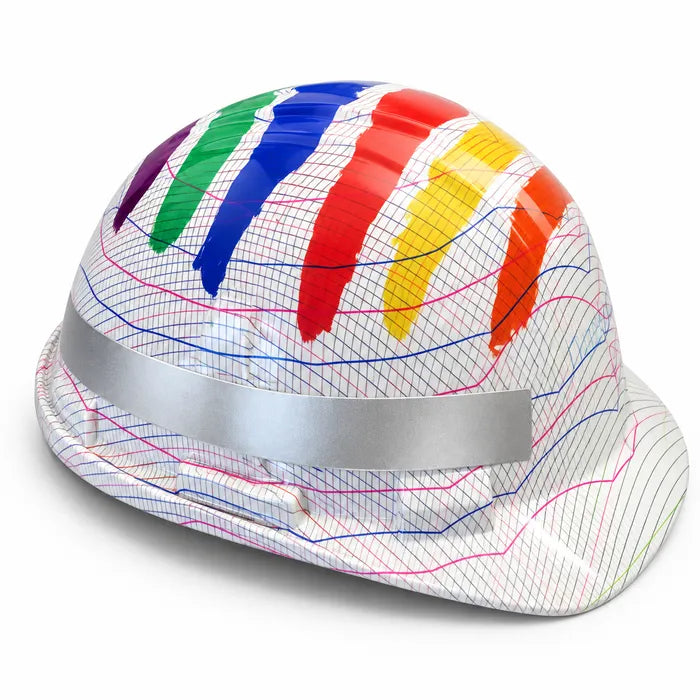
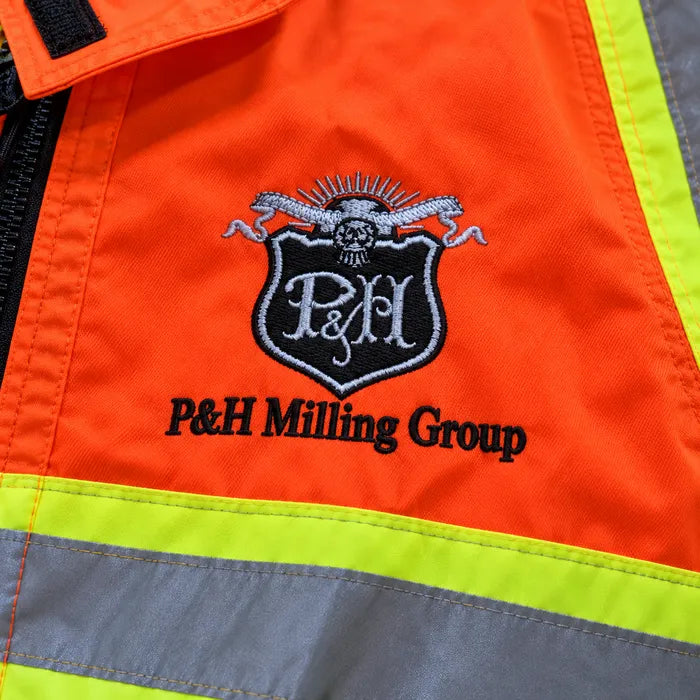
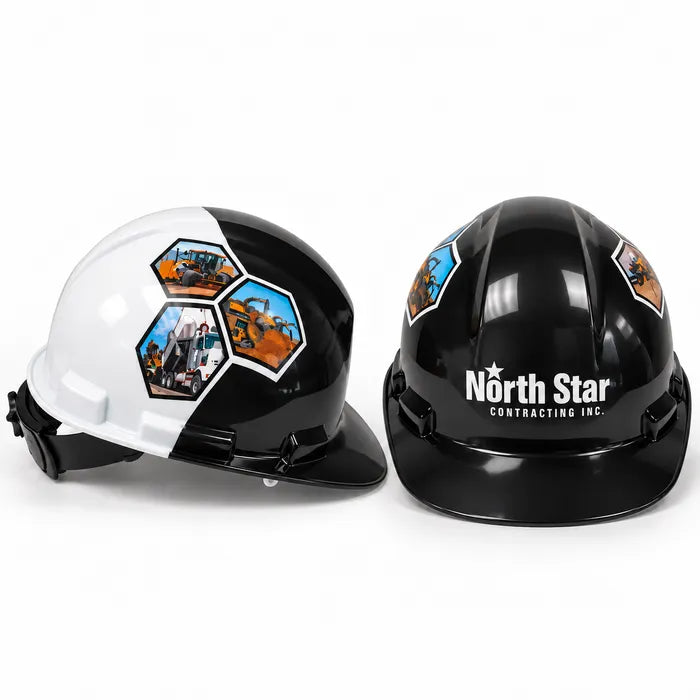
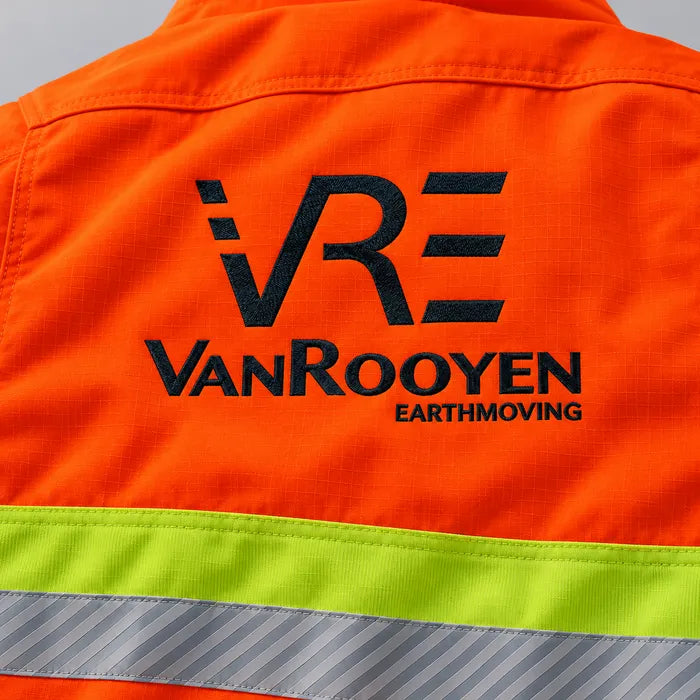
Keyline’s public customization gallery shows how artwork can be adapted across products. The examples here are existing public images, reproduced unchanged. They are design references—not customer endorsements, evidence of a particular helmet rating or a promise that an older configuration can be reordered.
Use these references to discuss a focused chest mark, a readable front helmet logo or a larger wrap concept. Avoid asking for a design to be copied onto a different protective product without checking compatibility.
Current logo offer: separate it from wrap quantities
As checked on November 7, 2026, Keyline’s homepage advertises free logo printing and embroidery on qualifying hi-vis clothing and hard hats until November 30, with a minimum of 24 pieces. See the custom-branded safety gear selection and confirm eligible products and decoration details before ordering.
The banner does not settle every order condition. Confirm whether quantities can be mixed, which logo positions and colours are included, and any artwork or setup conditions. Do not assume full wraps are included: the separate custom-wrap page lists a minimum of 107 hats per design. If reading after the promotion ends, request current terms rather than relying on this dated offer.
A quote checklist your safety and purchasing teams can share
- Work: industry, province, site requirements, tasks and the hazard assessment.
- Products: exact model/SKU, type, class, sizes, colours, retention and compatible accessories.
- Artwork: a clear logo file, preferably vector where available; brand colours; proposed dimensions and positions; permission to reproduce the artwork.
- Quantities: size breakdown, quantities per design and delivery destination; separate the wrap program from apparel/logo offers.
- Approval: manufacturer-permitted method, proof showing positions and dimensions, readable labels and inspection access.
- Commercial details: itemized product and decoration pricing, applicable offer terms and confirmed production/delivery arrangements. Do not assume stock or a lead time from a sample photograph.
- Repeat orders: retain the approved artwork version, model, decoration method and proof so replacements can be checked against the same specification.
For London and Southwestern Ontario teams, Keyline Safety can be a local starting point for that conversation. Share the requirements before committing to artwork. Start with custom head protection or the broader branded safety gear collection.
Related topics to plan next
- New-hire kits: coordinate identification while selecting PPE by role rather than issuing a single universal kit.
- Seasonal layering: check fit and visible striping when adding outerwear; a branded layer must not hide required hi-vis material.
- Multi-site procurement: keep one artwork standard and separate site-specific protective specifications.
- Replacement planning: track approved models and care instructions without treating a logo as a reason to keep damaged PPE in service.
Frequently asked questions
Can every hard hat be wrapped?
No. The exact model, wrap material, coverage and application method need manufacturer approval. Browse eligible options, then confirm the final configuration.
Does Type 2 mean Class E?
No. Impact type and electrical class describe different properties. Check both on the specific helmet and against the work requirements.
Can I put a large logo over the back X of a hi-vis jacket?
Do not cover the back striping with a non-retroreflective ID badge. Confirm the complete artwork and garment design before decoration.
Is the minimum order 24 or 107?
The homepage’s dated qualifying logo promotion states 24 pieces. The separate full-wrap program lists 107 hats per design. Product and service terms must be confirmed for your order.
Can branding make PPE compliant?
No. Compliance and suitability depend on the work, applicable requirements, product documentation, configuration, fit, use and maintenance—not the artwork.
Sources and further reading
Reviewed November 7, 2026. This is purchasing guidance, not a substitute for a site-specific assessment, manufacturer instructions or legal advice.


